
Key Takeaways
S-corp election can save $19,127/year in payroll taxes at $210K income (Slaton Financial, 2025)
SEP-IRA and Solo 401(k) contributions can be deducted up to $70,000 in 2025, slashing taxable income substantially
The 20% QBI deduction (Section 199A), now made permanent in 2025, saves $15K–$22K on $300K in pass-through income
100% bonus depreciation was restored in 2025: write off equipment costs in the year of purchase
Hiring family members and timing income strategically can push thousands more dollars out of high tax brackets
How Does S-Corp Election Cut Your Payroll Tax Bill?
The self-employment tax rate is 15.3% on all net earnings for sole proprietors and single-member LLCs (IRS, 2025). That's every dollar of profit. S-corp election lets owners split income between a salary (subject to payroll tax) and distributions, which aren't. At $210K, that split alone saves over $19,000 per year.
Here's the math. A sole proprietor earning $210,000 pays $32,130 in self-employment tax. An S-corp owner who draws a reasonable salary of $85,000 and takes the remainder as distributions pays $13,003 in payroll taxes, a difference of $19,127 per year (Slaton Financial, 2025). That's money that stays in the business.
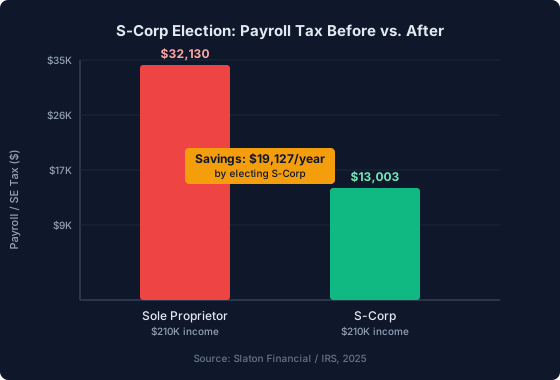
S-corp election reduces payroll tax on $210K income from $32,130 to $13,003, a saving of $19,127 per year. Source: Slaton Financial / IRS, 2025.
S-corp election generally makes financial sense when net profit exceeds $40,000–$80,000 per year. Below that, the additional administrative costs (payroll processing, separate filings, state fees) can eat into the savings. The IRS also requires you to pay yourself a "reasonable salary" before taking distributions. What's reasonable? It's what you'd pay someone else to do your job. Underpaying yourself is a common audit flag.
S-corp election allows business owners to split income between salary (subject to 15.3% payroll tax) and distributions (exempt from it). At $210K in income, this reduces payroll tax from $32,130 to $13,003, saving $19,127 annually, per Slaton Financial and IRS data (2025).
Which Retirement Account Saves Small Business Owners the Most?
In 2025, SEP-IRAs and Solo 401(k)s allow contributions up to $70,000, all pre-tax and fully deductible against business income (IRS Publication 560, 2025). That means every dollar you put in reduces your taxable income dollar for dollar. For a business owner in the 32% bracket, maxing a Solo 401(k) saves $22,400 in federal taxes alone.

Tax savings from retirement plan contributions in 2025 at the 24% and 32% federal tax brackets. A maxed Solo 401(k) saves $22,400 for owners in the 32% bracket. Source: IRS Publication 560, 2025.
Which plan is right for you? If you're a sole proprietor with no employees and want simplicity, the SEP-IRA wins on setup speed. If you want to maximize contributions while also building tax-free savings, the Solo 401(k) with a Roth component is worth the extra paperwork. Either way, the contribution deadline typically matches your tax return due date, including extensions.
In 2025, SEP-IRAs and Solo 401(k)s allow small business owners to contribute up to $70,000 in pre-tax income, fully deductible against business earnings. An owner in the 32% federal bracket who maxes out a Solo 401(k) reduces their federal tax bill by $22,400, per IRS Publication 560 (2025).
What Is the QBI Deduction and Does Your Business Qualify?
A total of 25.9 million businesses claimed the Section 199A QBI deduction in 2021 (American Farm Bureau Federation, Feb 2025). On $300,000 of pass-through income, this deduction reduces taxable income by $60,000, saving between $15,000 and $22,000 in federal taxes (Taxstra, 2025). And it's now permanent.
The deduction applies to 95% of U.S. businesses, which are structured as pass-through entities (Econofact, 2021). That includes sole proprietors, S-corps, partnerships, and LLCs taxed as any of those. The basic math: deduct 20% of your qualified business income before calculating your tax. No extra work, no separate entity. Just a line on your return.
Here's the part most founders miss: the QBI deduction supports 2.6 million workers and contributes $325 billion to U.S. GDP annually (American Farm Bureau Federation, Feb 2025). That scale is why Congress made it permanent under the One Big Beautiful Budget Act (OBBBA) in 2025. It's not going away, which means multi-year planning around it is now possible.
Income thresholds apply for "specified service trades or businesses": doctors, lawyers, consultants, financial advisors, and similar professionals. For those owners, the deduction phases out above roughly $197,300 (single filers) or $394,600 (married filing jointly) in 2025. Above those thresholds, the deduction disappears entirely for SSTBs. Other businesses aren't subject to the phase-out in the same way.
The Section 199A QBI deduction allows eligible pass-through business owners to deduct 20% of qualified business income. On $300,000 in pass-through income, this reduces taxable income by $60,000, saving $15,000 to $22,000 in federal taxes, per Taxstra (2025). The deduction was made permanent under the OBBBA in 2025.
How Does Bonus Depreciation Work After the 2025 OBBBA?
Under the OBBBA, 100% bonus depreciation was permanently restored for qualified assets placed in service after January 19, 2025 (Grant Thornton, 2025). Instead of spreading a deduction across 5 to 7 years, you write off the full purchase price in year one. Buy a $50,000 piece of equipment in December, and you've reduced taxable income by $50,000 this year.

What qualifies? The list is broad: computers, servers, machinery, office furniture, vehicles under 6,000 pounds, and off-the-shelf software all count. Improvements to non-residential real property may also qualify under certain conditions. The key rule is that the asset must be placed in service (meaning actively used in the business) before December 31 of the tax year.
How much does bonus depreciation actually save you? That depends on your effective tax rate. The chart below shows how much rates vary across industries, and why your specific rate determines the real dollar value of every dollar you depreciate.
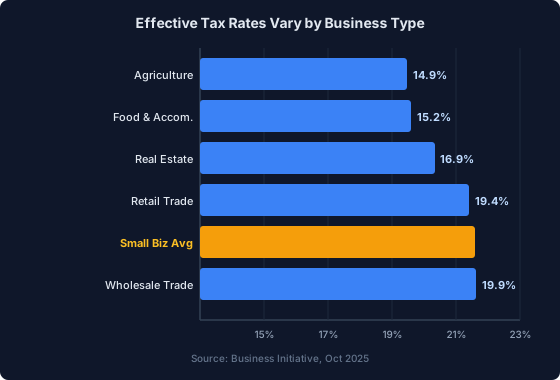
Effective federal tax rates for small businesses vary meaningfully by industry. Agriculture pays the least at 14.9%; the overall small business average is 19.8%. Source: Business Initiative, Oct 2025.
You can also combine bonus depreciation with Section 179 expensing for more flexibility. Section 179 lets you control which assets get the immediate deduction and carry forward any limits, while bonus depreciation applies automatically to remaining eligible property. Together, they give you precise control over when large equipment purchases hit your tax return.
The OBBBA permanently restored 100% bonus depreciation for qualified business assets placed in service after January 19, 2025. This allows small business owners to deduct the full purchase price of eligible equipment (computers, machinery, furniture, and qualifying vehicles) in the year of purchase rather than over 5 to 7 years, per Grant Thornton (2025).
Is Your Home Office Deduction Actually Going to Hold Up?
The IRS simplified home office deduction caps at $1,500 per year: $5 per square foot for up to 300 square feet (IRS, 2025). The actual expense method yields more for most founders. But neither method helps if the deduction gets disallowed on audit, which happens regularly when the exclusive-use rule isn't met. A desk in a shared living room doesn't qualify. A kitchen table used for both calls and dinner definitely doesn't.

Two calculation methods exist. The simplified method is fastest: $1,500 per year, no receipts required. The actual expense method calculates the percentage of your home used for business and applies it to real costs: rent or mortgage interest, utilities, internet, renter's or homeowner's insurance, and depreciation. The actual method almost always produces a larger deduction but requires more record keeping. In our experience, most founders underestimate how much the actual method saves compared to the simplified cap.
In our experience, founders frequently lose this deduction by using a guest bedroom or kitchen table that doubles as personal space. A dedicated room, even a small one, is the cleanest route. Paint the guest bed out of there and document the conversion with dated photos. That paper trail can matter more than the deduction size if the IRS ever asks.
The home office deduction also unlocks a proportional deduction for home repairs and improvements. Fix the roof on a house where 20% is used for business? Twenty percent of that cost may be deductible. Most founders don't realize this benefit applies.
The IRS home office deduction requires the space to be used exclusively and regularly for business. Qualifying owners can use the simplified method ($5/sq ft, max $1,500/year) or the actual expense method, which applies the business-use percentage to real costs like rent, utilities, internet, and home depreciation for a typically larger deduction.
Strategy 6: Put Family Members on Payroll to Shift Income
Wages paid to children under 18 in a sole proprietorship or partnership are exempt from FICA taxes (Social Security and Medicare) under IRS rules (IRS, 2025). For a business owner in the 32% bracket, paying a child $14,600 (the 2025 standard deduction) shifts that income to a 0% federal tax rate. That's a $4,672 tax saving from a single move.
Stack the strategy for even greater impact. The child earns wages that are deductible to you. They use the standard deduction and pay $0 in federal income tax. You then fund a custodial Roth IRA with those wages, up to the amount earned. You've effectively moved money from 32% taxable income into a tax-free retirement account. That's not a loophole. That's the tax code working exactly as designed.
Adding a spouse to payroll opens different doors. A spouse who earns wages can participate in their own Solo 401(k), doubling the household's retirement contribution capacity. Spouses employed by the business may also allow the company to deduct health insurance premiums more cleanly. Both are legitimate strategies that most small business owners never explore.
From what we've seen, the IRS does scrutinize family payroll arrangements. The work must be real, the wages must be reasonable for the role, and records should match. Pay via direct deposit, keep timesheets, and document duties. Done right, this is one of the most effective income-shifting tools in the tax code.
Wages paid to children under 18 in a sole proprietorship or partnership are exempt from FICA taxes under IRS rules (IRS, 2025). Paying a child up to the $14,600 standard deduction in 2025 shifts that income to a 0% federal rate, saving a 32% bracket owner $4,672. Those earnings can then fund a custodial Roth IRA.
Strategy 7: Time Your Income and Deductions to Lower Your Annual Bill
With 96% of U.S. businesses structured as pass-through entities (Econofact, 2021), income timing is one of the most universally applicable strategies in this list. Cash-basis businesses recognize income when received and expenses when paid. That gives you direct control over your taxable year. The question isn't whether you can time things. It's whether you're doing it on purpose.
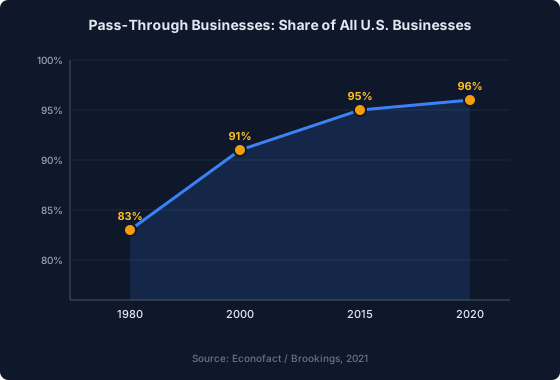
he share of U.S. businesses structured as pass-through entities has grown from 83% in 1980 to 96% in 2020, making income timing strategies increasingly relevant for American business owners. Source: Econofact / Brookings, 2021.
Here's how to use this in practice. If December looks like a big revenue month, hold invoices until January. That defers income into the next tax year. At the same time, prepay January expenses in December: rent, insurance premiums, software subscriptions, even quarterly estimated tax payments, pulling deductions into the current year.
The reverse works too. If you're having a low-income year, accelerate revenue now. You'll pay taxes on it at a lower effective rate than in a higher-income year. And if you're planning a major equipment purchase anyway, the end of a high-income year is almost always the right time to pull the trigger.
What shouldn't you do? Don't hold checks or delay deposited revenue artificially. The IRS has constructive receipt rules that can pull income into the current year even if you haven't cashed the check. The timing has to be real.
Cash-basis small businesses control their taxable year by choosing when to receive income and pay expenses. Year-end strategies include deferring December invoices to January, prepaying January expenses in December, and accelerating equipment purchases before year-end to maximize bonus depreciation in a high-income year.
Ready to cut your tax bill this year?
These strategies work best when coordinated. The right combination of S-corp election, retirement contributions, and deductions depends on your income level, entity structure, and state tax rules. Talk to a CPA who specializes in small business before year-end.
Frequently Asked Questions About Small Business Tax Planning
What is the best tax structure for a small business?
Most small businesses benefit from S-corp or LLC taxation once net profit exceeds $40,000–$80,000 per year. The 15.3% self-employment tax on sole proprietor income is the primary driver. S-corp election can eliminate it on distributions, potentially saving $10,000–$20,000 annually depending on income level and salary structure.
How much can a small business owner reduce their taxes legally?
Quite a lot, if you stack the right tools. Combining an S-corp election, a maxed SEP-IRA or Solo 401(k), the 20% QBI deduction, and bonus depreciation can reduce federal taxable income by $100,000 or more for a $300K-income business. The exact number depends on your bracket, entity type, and which deductions apply to your situation.
When should I elect S-corp status?
S-corp election typically makes financial sense when net business profit exceeds $40,000–$80,000 per year on a sustained basis. Below that threshold, the administrative costs (payroll processing, separate state filings, additional compliance) can outweigh the payroll tax savings. Consult a CPA before filing IRS Form 2553, and check your state's treatment of S-corps, since some states don't recognize the election or add their own taxes.
Can I deduct health insurance premiums as a small business owner?
Yes, and it's a substantial benefit. Self-employed business owners can deduct 100% of health insurance premiums paid for themselves, their spouse, and dependents, directly from gross income and not as an itemized deduction. S-corp shareholders who own more than 2% must have premiums included in W-2 wages first, then deduct them on Schedule 1. Either way, the deduction is real and worth claiming.
The Bottom Line
Tax planning strategies for small business aren't complicated, but they do require intention. A few things worth remembering:
The strategies compound. S-corp election lowers the income subject to payroll tax. Retirement contributions then reduce the income subject to income tax. The QBI deduction reduces it further. Stack them.
Year-round planning beats April filing. The best moves (entity elections, retirement account openings, equipment purchases) have hard deadlines that don't wait for tax season.
Documentation is the difference between a deduction and an audit flag. Real wages for real work. Exclusive use for home offices. Dated records for everything.
23% of small business owners spend over $10,000 per year on tax compliance (NSBA via Business Initiative, Oct 2025). A good CPA who specializes in small business often pays for themselves in the first year.
Start with the strategy that matches your current income level and entity structure. Then build from there.


